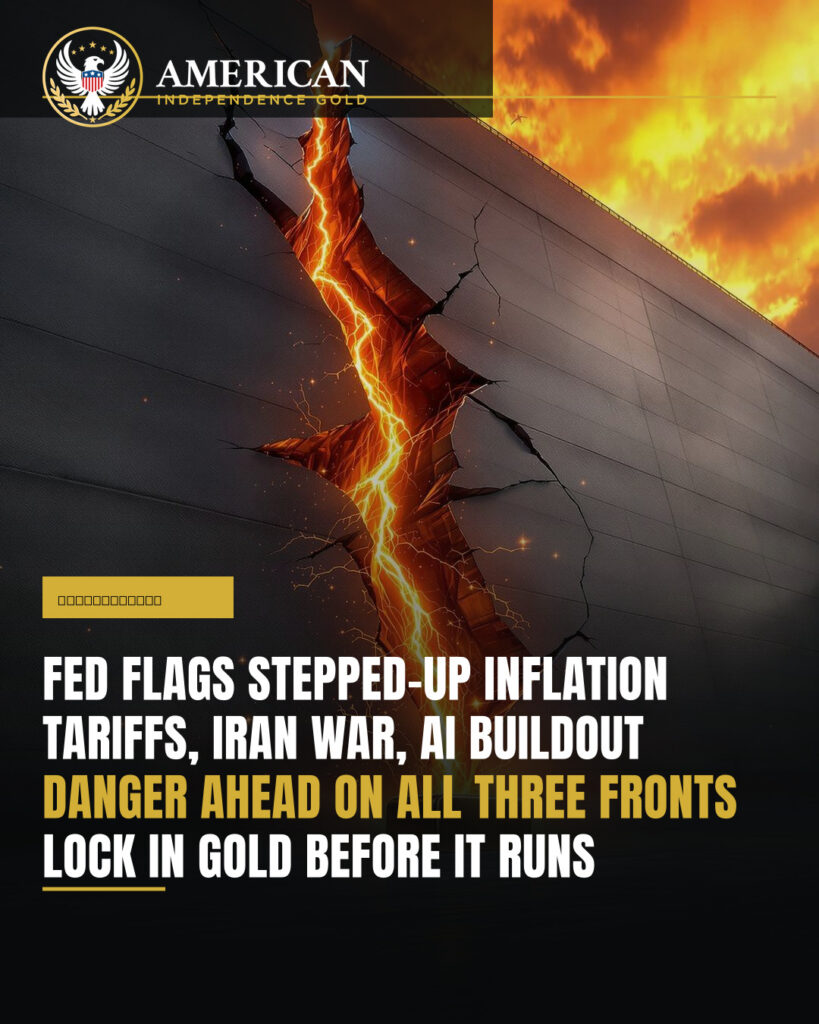
The Federal Reserve doesn’t sound alarms often. So when its latest report calls out stepped-up inflation from three separate directions at once, that’s worth paying attention to. Tariffs, the Iran conflict, and the AI investment boom are all pushing prices higher, and the Fed’s own language makes clear that officials are watching all three fronts closely. For everyday Americans trying to protect their savings, the timing couldn’t feel more urgent.
Understanding what’s actually driving inflation right now, and what you can do about it, is the first step toward making smarter decisions with your money. That’s exactly what this article breaks down.
Three Inflation Drivers the Fed Is Watching Right Now
The Fed’s report didn’t single out one culprit. It pointed to three distinct forces all working in the same direction, all at the same time. That kind of stacking effect is what makes this moment different from typical inflationary periods. When multiple pressures converge, the result tends to be more stubborn and longer-lasting than inflation caused by a single event.
Tariffs Are Making Everyday Goods More Expensive
Higher tariffs mean companies pay more to import goods, and those costs almost always get passed along to consumers. Whether you’re buying electronics, appliances, clothing, or building materials, tariffs have a way of quietly raising prices across entire product categories. The Fed flagged this specifically because tariff-driven inflation is structural, meaning it doesn’t just spike and disappear. It tends to stay elevated as long as the trade policy remains in place. For working families and retirees on fixed incomes, that kind of persistent price pressure is especially damaging because it erodes purchasing power month after month.
Geopolitical Tension in Iran Is Rattling Energy Markets
Conflicts in the Middle East have historically sent oil prices higher, and the current situation involving Iran is no different. When energy costs rise, the effect ripples through the entire economy. Shipping gets more expensive. Manufacturing costs go up. Grocery prices climb because food distribution depends on fuel. The Fed’s decision to include the Iran situation in its inflation report signals that officials believe the geopolitical risk is real and material, not just background noise. Energy price shocks can be fast and severe, and they tend to hit lower and middle-income households the hardest.
The AI Buildout Is Driving Up Demand Across the Board
This one surprises some people. The artificial intelligence boom is creating enormous demand for data centers, semiconductors, electricity infrastructure, and skilled labor. That demand is inflationary because it competes with other parts of the economy for the same resources. Power grids are being strained. Construction crews are stretched thin. Chip prices are elevated. The Fed is watching this carefully because AI investment isn’t slowing down, which means the demand-side pressure it creates could be with us for years, not months.
What Inflation Actually Does to Your Savings
Inflation is sometimes described in abstract terms, but the real-world effect is straightforward. When prices go up, every dollar you have saved buys less than it did before. A retirement account that looks healthy on paper can quietly lose ground in real terms if inflation is running faster than your returns. This is particularly relevant for anyone holding cash, bonds, or other fixed-income assets, since those instruments often struggle to keep pace with rising prices.
The dollar’s purchasing power has already declined significantly over the past several years. Adding three new inflation drivers on top of an already weakened baseline is exactly the kind of environment where traditional savings strategies start to feel inadequate. That’s not pessimism. It’s just math.
If you want to understand the basics of how gold fits into this picture, why gold matters as an asset is a good place to start. Gold has historically held its value during inflationary periods precisely because it’s not tied to any single government’s monetary policy.
Why Gold Tends to Respond When Inflation Heats Up
Gold’s relationship with inflation isn’t a coincidence or a marketing claim. It’s rooted in how gold behaves as an asset. Unlike paper currency, gold can’t be printed. Its supply grows slowly, and its value isn’t dependent on any central bank’s decisions. When inflation rises and the purchasing power of the dollar falls, gold often moves in the opposite direction because investors look for stores of value that hold up under pressure.
That dynamic is playing out right now. You can check the current gold price to see how the market is already responding to the inflationary signals the Fed has highlighted. Gold doesn’t wait for inflation to peak before it starts moving. Historically, it responds to the expectation of inflation, which means waiting for confirmation often means missing the early move.
This is also why a Gold IRA or Precious Metals IRA has become an increasingly common strategy for retirement savers who want exposure to gold within a tax-advantaged account structure. Rather than holding gold in a separate brokerage account, a Gold IRA lets you own IRS-approved physical gold as part of your retirement portfolio, with the same tax treatment you’d get from a traditional IRA.
How a Gold IRA Works as an Inflation Hedge
A Gold IRA functions like a standard individual retirement account in most ways. You get the same contribution rules, the same tax-deferred growth potential, and the same basic framework. The key difference is that instead of holding stocks, mutual funds, or bonds, the account holds physical precious metals stored in an IRS-approved depository.
For people who already have retirement savings in a 401(k) or traditional IRA, a rollover is often the simplest path. You can move existing funds into a Gold IRA without triggering a taxable event, which means you’re not giving up any of your savings in the process. The team at American Independence Gold walks clients through every step of that process, from paperwork to custodian selection to metal delivery to the depository.
If you’re considering this route, learning how a Gold IRA works before you make any decisions is a smart move. Understanding the structure, the rules, and the benefits gives you a much clearer picture of whether it fits your situation.
Frequently Asked Questions
Why does the Fed flagging inflation matter for gold investors?
When the Federal Reserve identifies rising inflation risks in its official reports, it signals that price pressures are broad and potentially long-lasting. Gold has historically performed well during inflationary periods because its value isn’t tied to any single currency. Fed warnings often precede sustained gold price appreciation, making them an important signal for investors considering a Gold IRA or physical precious metals.
How do tariffs cause inflation and what does that mean for my savings?
Tariffs raise the cost of imported goods, and companies typically pass those costs on to consumers through higher prices. This kind of inflation is structural, meaning it persists as long as the tariffs remain in place. For savers, especially retirees on fixed incomes, sustained tariff-driven inflation erodes purchasing power over time and makes it harder for traditional savings accounts or bonds to keep up.
What is a Gold IRA and how is it different from a regular IRA?
A Gold IRA is a self-directed individual retirement account that holds physical, IRS-approved precious metals instead of stocks or bonds. It offers the same tax advantages as a traditional IRA, including tax-deferred growth. The metals are stored in an approved depository on your behalf. It’s a legal, structured way to add gold exposure to your retirement savings without opening a separate brokerage account.
Can I roll my existing 401(k) into a Gold IRA without paying taxes?
Yes, in most cases you can roll a 401(k) into a Gold IRA through a direct rollover without triggering a taxable event or early withdrawal penalties. The process involves selecting a Gold IRA custodian, opening the account, and initiating the transfer from your existing plan. American Independence Gold guides clients through each step to make sure the rollover is completed correctly and efficiently.
Is now a good time to open a Gold IRA given current market conditions?
With the Fed identifying multiple simultaneous inflation drivers, including tariffs, geopolitical tension, and AI-driven demand, many financial professionals consider this an appropriate environment to evaluate gold as a portfolio hedge. Gold tends to respond to inflationary expectations before inflation peaks, which means acting early can be more effective than waiting for conditions to worsen. Individual circumstances vary, so speaking with a specialist is always the right first step.
If the Fed’s report has you thinking seriously about protecting your retirement savings, now is a good time to take a closer look at your options. The team at American Independence Gold is available to answer your questions and help you figure out whether a Gold IRA or Precious Metals IRA makes sense for your situation. You can contact us online or call directly at (844) 714-4653 to speak with a specialist today.